Max Bouvatte
Live music is back, baby.
At the start of the COVID-19 pandemic, the predictions for the live music industry were dire.
According to some early estimates, most smaller venues in the U.S. would close without a financial lifeline. One such warning came from Dayna Frank, president of the National Independent Venue Association, a lobbying group that formed in March 2020 to try to get federal aid for the industry. Frank told Rolling Stone that 90 percent of the group’s member sites reported not having enough cash on hand to last more than six months without federal intervention, and 55 percent did not have enough to last more than three months.
Fortunately, that assistance came in the form of the Save Our Stages Act, which was included in a $900 billion stimulus bill passed by Congress in December 2020. While this avoided worst-case scenarios, The live music landscape has changed considerably since we all first heard the word “coronavirus”.
Here in St. Louis, the old standbys have closed their doors and new ones, mostly bigger ones, have arrived on the scene with a splash. We mourn those we’ve lost – RIP the Way Out Club, one of the best ever – while celebrating those we’ve won.
There’s Red Flag, a 1,000-cover Midtown venue that opened in November 2020 across from the considerably smaller Fubar, which was under the same ownership and closed when Red Flag opened. There’s the Ready in the Grove venue, which closed at the height of the pandemic, only to resurface this year in a new space: the former Atomic Cowboy, which never officially announced it was closing, though its furniture went up for sale in February 2021. The Ready Room’s former digs have since been transformed into Hot Java Bar. The Monocle eventually closed in October 2020, while Platypus opened across the street a year later.
Also notable are the major additions that appeared in the county, including the open-air amphitheater St. Louis Music Park $9 million in Maryland Heights, which opened in July 2021 as the final piece of the Centene Community Ice Center. Even further west is the Chesterfield Factory, a $23 million building in the District’s entertainment complex. Through its partnership with high-impact booking agency Contemporary Productions, the venue has managed to bring together some top-tier acts since opening in July 2021.
Still, even for the elderly, COVID-19 brought its fair share of challenges.
“It affected the artists — they weren’t traveling as much,” factory owner Michael Staenberg says of the site’s early days. “That’s really what affected us, it was the shows. When you have less shows, it’s kind of hard to get anything done.”
STEPHEN INMAN
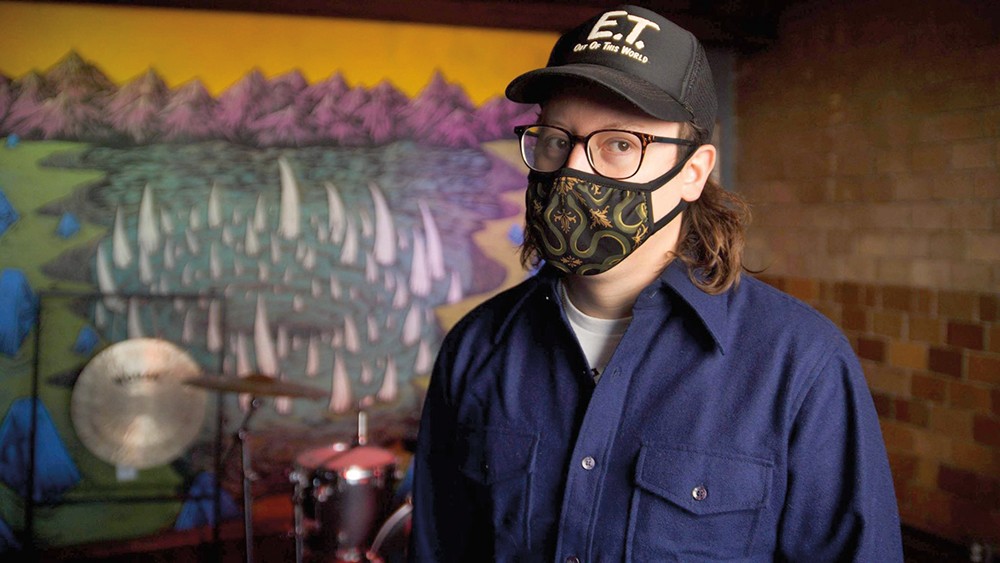
Matt Stuttler worked hard to keep the Sinkhole open.
But as things have started to open up, and artists are hitting the road more often, that problem has begun to be resolved and the Factory has increasingly found its place as part of the local music scene.
“Our last few shows have been 80, 90, 100 percent sold out,” Staenberg says. “People really embrace us and really understand who we are and what we’re about.”
Where St. Louis seems to be lacking most at the moment in the smaller and more intimate venues. The loss of the Way Out Club was a major blow, but some of the problems predate the pandemic. Foam closed in December 2019, and the 2720 Performing Arts Center closed a year and a half earlier, at the same time Blank Space ceased regular hours.
Still, there’s plenty of room for optimism on the smaller venues front: 2720 has seen new life recently, opening this year as Golden Record, and Attic Music Bar made its debut in Southampton in July 2021. Meanwhile, blues stalwarts like Broadway Oyster Bar and BB’s are still going strong, and venues like the Duck Room, Heavy Anchor, Off Broadway, CBGB and Focal Point are also making strides.
Those sites that stayed afloat over the past few years didn’t do so by magic. According to Matt Stuttler, owner of punk venue Sinkhole, which closed for more than a year, it took a fair amount of work to keep his dream alive through the worst of the pandemic.
“The biggest thing was getting into grant writing,” explains Stutter. “So I spent a lot of time going through all the government aid and liberal arts grants.”
That work seems to have paid off, and Stuttler is cautiously optimistic that his venue has come out on the other side, something that can hopefully be said for every live music establishment in St. Louis.
“Everything is back to normal. I think we’re looking at 29 shows this month, and I’d say since March of this year it’s been an average of 20 to 25 shows a month,” he says. “Which is pretty much where we were right before COVID.”


