Quick, what’s the first thing you think of when I say “bouncy house”? If your mind was flooded with images of flashy bounce houses swinging with screaming children, you’re in for a surprise.
For the past year and a half, New York startup Automatic Construction has been developing a construction technique that allows its workers to blow up a house and pump concrete into its walls. The company estimates that homes built using this technique can be erected in less than an hour and cost about one-fifth the price of more traditional cast-in-situ concrete methods used to build commercial structures and single-family homes in the US
[Photo: Automatic Construction]
It’s an unusual method, but for a world mired in a housing crisis, it’s very promising. By 2030, the UN estimates that we will have to build 96,000 affordable homes per day to accommodate the 3 billion people who will need access to adequate housing. With the goal of speeding up construction and reducing costs, architects and construction companies alike have embraced 3D printed homes, modular buildings, and even robots. For automatic construction, the answer is in a patent pending construction technique called flexible inflatable factory formwork. “Our solution is packaged small and inflated on site,” says Alex Bell, the company’s CEO.
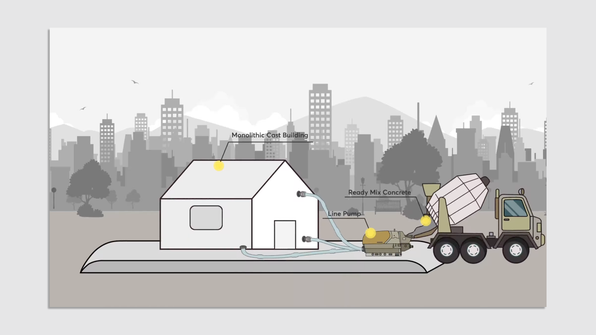
The idea: A truck offers a rolled-up version of the future home. The structure, made of PVC, is rolled up and inflated using conventional construction air compressors. In fact, two structures are inflated at this stage. The first, called shoring, sits inside to prop up the approaching building while it’s cast and supports the weight of the roof. The second is the actual bouncy house, which is technically only inflated long enough for the concrete to be pumped from one end while air is sucked in from the other.
 [Image: Automatic Construction]
The material is then cured for about two days, after which it is deflated and stored for reuse. However, it should be noted that the other envelope containing the now solid concrete is not removed, acting instead as a natural barrier that is waterproof and airtight. (Regular insulation and cladding would still be required afterwards, so the houses’ current aesthetic, i.e. a box wrapped in gray plastic, would not show up in the final result.) For now, the company is using PVC virgin, but Bell says they can switch to recycled. (Rebar reinforcements are still needed in the concrete, and while some are installed on-site, Bell says they will eventually be pre-installed at the factory.)
So far, the company has built prototypes for a 100-square-foot structure and a 200-square-foot structure, and they’re now working on two ADUs and a 650-square-foot single-story home in Nova State York. The house would take about 15 minutes to inflate and a little over an hour to fill with concrete. It would cost between $10 and $30 per square meter. Compared to the average cost of new construction in the US, which ranges from $100 to $200 per square foot, this estimate is quite impressive. And while that price only gets you a basic structure with four walls and a roof (think no drywall, no siding, no mechanicals, no finishes, etc.), it means that a significant cost component of the traditional concrete construction could be up to 80% cheaper.
 [Photo: Automatic Construction]
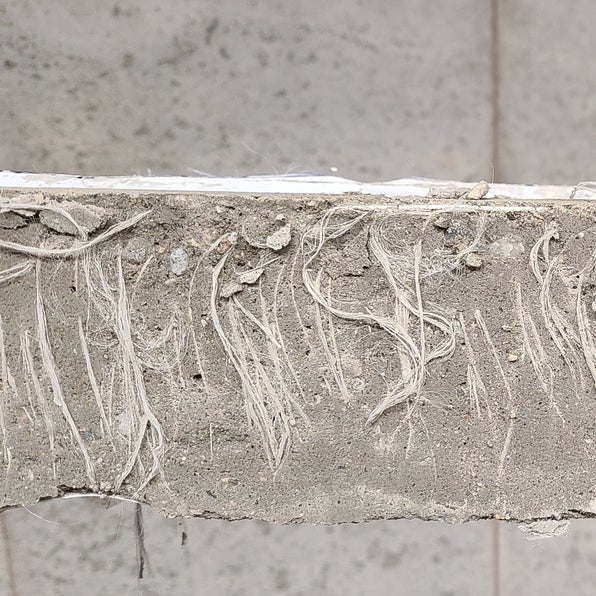
If you’re still getting bouncy castle vibes from all of this, I should note that this is not your typical bouncy. The 4-inch-thick walls are filled with tens of thousands of polyester threads known as drop stitch fibers. Once used by Goodyear to make an inflatable airplane called inflated plane (this project was short-lived for obvious reasons), these fibers are now used to make paddle boards, kayaks, and even inflatable Adirondack chairs.
 [Image: Automatic Construction]
In this case, they provide tensile reinforcement and allow the walls to maintain both their shape and pressure during casting. So put aside the images of the floppy bouncy house and get ready for the bouncy houses you could live in: screaming children, optional.

:quality(70)/cloudfront-us-east-1.images.arcpublishing.com/shawmedia/HU34JXRKABHJPO7HV5ALWTVH44.jpg "Church groups hand out hundreds of backpacks and school supplies at La Salle Summer Fest – Shaw Local")