Courtesy of the Missouri History Museum
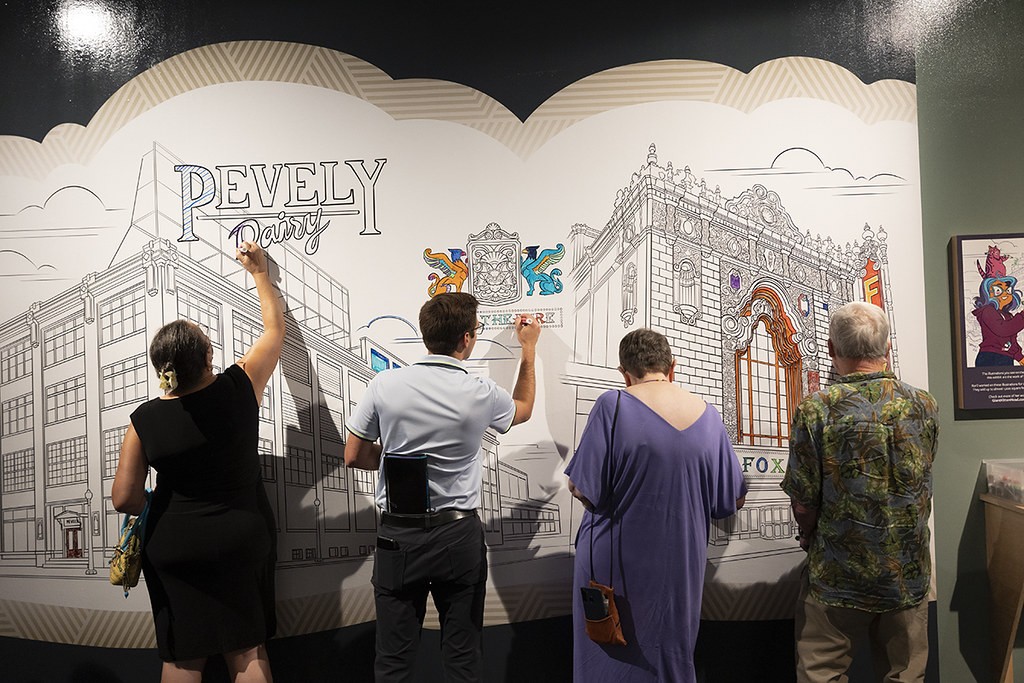
Visitors try Coloring STL during a member’s preview.
On the walls of the Missouri History Museum pops of color pop out of the black and white outlines. Along the walls of the 6,000-square-foot special exhibit space are illustrations of 50 local structures printed on a whiteboard-like material. Buckets of dry erase markers are put to good use for visitors.
Here and there attendees at the previous night’s members’ preview have added drawings: spiderwebs and people in windows, a plane shooting King Kong climbing up Union Station, or a ghostly woman with hair blowing in an alien wind atop the Lemp brewery.
“Creativity is already coming out,” says Andrew Wanko, public historian at the Missouri History Museum and responsible for the exhibit’s content.
Color, drawings and outlines are part of Coloring STL, an interactive exhibition that invites attendees to learn about the history of St. Louis architecture by drawing on the walls. The exhibition opens to the public tomorrow and runs until May 5, 2024.

Courtesy of the Missouri History Museum
Coloring STL opens tomorrow at the Missouri History Museum.
The illustrations, which were created by the artist of St. Louis Highway!, ranging from the historical to the modern. The oldest structure represented is an Illinois longhouse from the 1700s, and the most recent is the 100 Above the Park Central West End building. Others represented include Homer G. Phillips Hospital, Tony Faust’s Oyster House and Restaurant, Tower Grove Park shelters and University City’s City Hall.
“We picked sizes, styles, eras, everything,” says Wanko. “They were buildings that are great landmarks, buildings that are lost buildings, some that were more like neighborhood-scale treasures.”
He points to the Railroad Exchange Building, built in 1914, which occupies an entire block and once housed a famous Giant Barr as well as office space. Newspapers at the time touted it as having more people on a busy day than the entire city of Dallas, Texas.
“If you were alive in St. Louis in 1914, this would have been the landmark you would have wanted to see,” he says.
One wall features a color-coded timeline of 21 common residential building styles, an accessible way for visitors to learn about the architecture that most likely affects them. Styles include gingerbread houses from St. Louis, two-family duplexes and even the Meet Me in St. Louis, as well as the house that Sally Benson actually lived in.
In addition to the colorful walls, Coloring STL includes interactive exhibits that explore other facets of St. Louis’ architectural history, including the different varieties of red brick and those iron stars that can be seen on brick homes throughout the city .
It turns out that these stars are functional, not decorative, and were installed to prevent the brick walls from sagging outward.
“Sometimes you’ll see them randomly in a place,” says Wanko. “This is the sign that something went wrong in this building later.”
Other sections include original plans of various buildings; stained glass windows; common building materials such as sandstone, the history that is lost when buildings are demolished; and alternative designs from the competition that resulted in the Gateway Arch, including a design by Gyo Obata, the founder of HOK who died this year, that featured a 40-foot statue of Thomas Jefferson.

Courtesy of the Missouri History Museum
Painting on the walls is recommended.
Wanko and others at the museum have long wanted to do an architecture exhibit because of frequent questions the museum receives from attendees about the subject. They knew they wanted to make it interactive, but weren’t sure how to do it initially.
Then the idea of painting came. Almost immediately there was a sense that this was going to be a success, even if it was something crazy that no one had done before on this scale.
Right at the start of the pandemic, Wanko began working on the exhibit, a pretty quick turnaround from start to finish. Now that opening weekend is coming up, he’s excited to let visitors in on the fruits of those efforts for themselves.
“It’s my hope that in the long run, in its own small way, this exhibit will help build pride and ownership in St. Louis, get people excited about the city,” Wanko says. “There are so many fascinating stories and things hidden in the blocks we walk on every day. That’s ultimately what I hope the takeaway is: that it inspires people to love St. Louis and explore the city even more.
Coloring STL’s opening weekend is Saturday, August 20 and Sunday, August 21 from 10 a.m. to 5 p.m. at the Missouri History Museum (5700 Lindell Boulevard, 314-746-4599). At 2:00 p.m. on Saturday, August 20, the museum will give a masterful presentation entitled St. Louis Architecture: Past, Present, and Future. On Sunday, August 21 at 2:00 p.m., they will perform the masterful event Architecture and Acrobats. All events are free and the exhibition will be open until May 5, 2024.
Email the author at [email protected]