It’s all fun and games until someone gets hurt… or dies. And a lack of regulation and oversight around a popular rental-friendly party feature could be putting tens of thousands of children at risk, according to new research from the University of Georgia.
The to study found that at least 479 people were injured and 28 died worldwide in more than 130 bounce house accidents due to weather events since 2000. But researchers caution that these estimates are likely an undercount .
These injuries add up to approximately 10,000 emergency room visits in the US each year due to bounce house-related accidents that commonly result in broken bones, muscle sprains and concussions.
John Knox
“These bounce houses are not something you set up and then forget to stake in the ground,” he said. John Knoxlead author of the study and professor of geography at the Franklin College of Arts and Sciences. “What could go wrong? The answer is that it could blow with winds that are nowhere near severe levels. Some of these cases were in purely clear skies.”
Many of the wind-related accidents happened on what appeared to be good weather days, according to the research: a cool, sunny day following a cold front with clear skies, a hot but calm day that triggers a dust devil, or a pleasant summer day. with a storm somewhere far away. More than 80 of the 132 events identified by the study were caused by cold fronts or post-cold front conditions, dust devils, and airborne or distant storms.
Even lower wind speeds pose a risk to playhouse safety
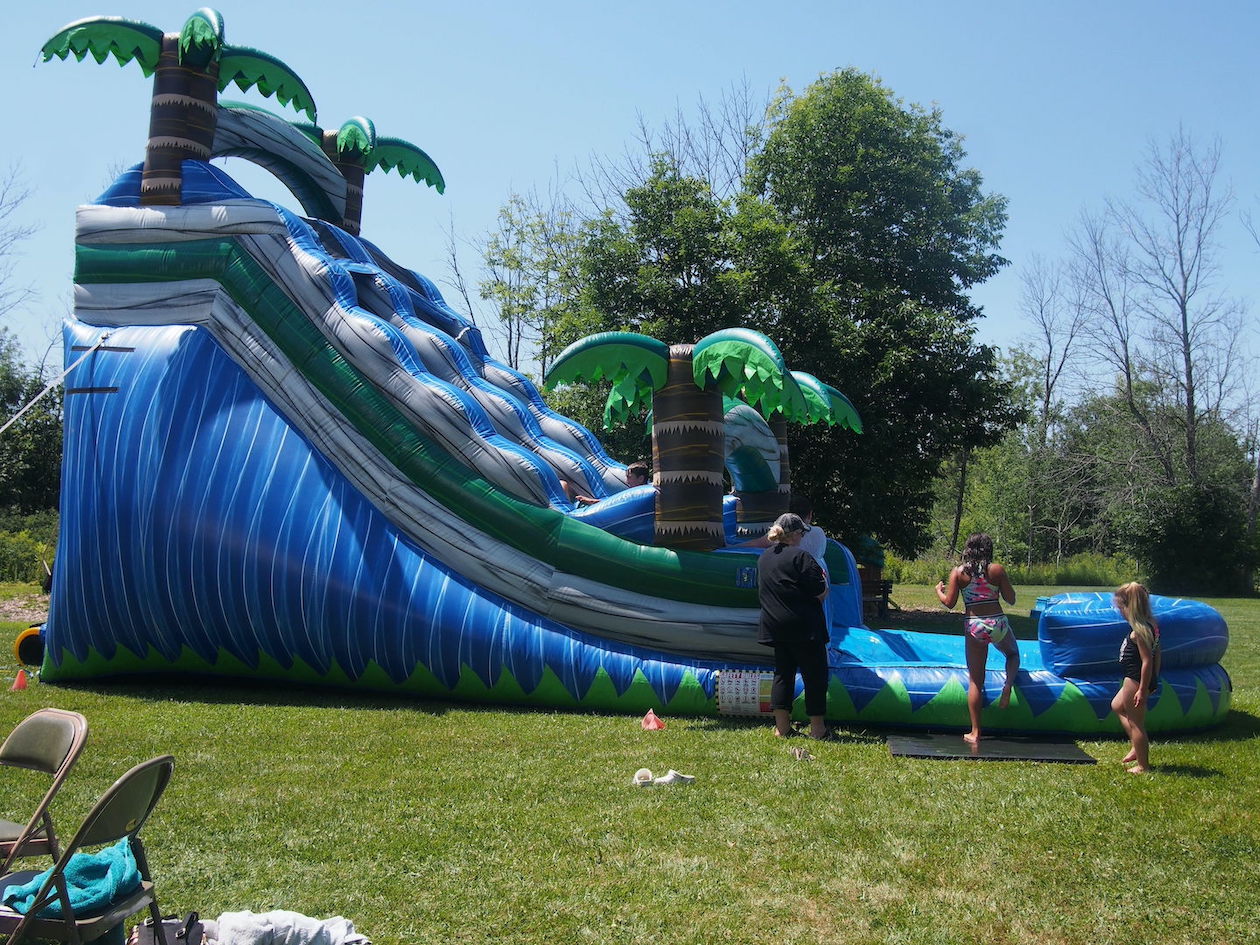
Also known as bouncy houses, magic castles, bouncy balloons or bouncy castles, bouncy houses are common props at birthday parties, carnivals and even wedding receptions. They cost less than $100 to rent on average in the US and are an easy and fun way to keep kids (and some adults) entertained for hours.
But the study found that it didn’t take high wind speeds to topple the bouncy houses, lift them into the air or send them bouncing to the ground for meters, often while people were still inside.

Thomas Gill
“There was a case in Southern California where one of the bounce houses got caught in the wind and fell in the middle of the road with a child still inside the playhouse,” said Thomas Gill, second author of the paper and professor of environmental science at the University of Texas at El Paso. “When the winds become too much, these bounce houses not only have to be evacuated, but also deflated. There have been cases where a bounce house was empty, but it blew up and hit a bystander.”
Basic precautions such as safely placing bounce houses on the ground, attaching sandbags to weigh down the structure, and monitoring wind speeds and other dangerous weather conditions likely could have prevented many, if not all, of the accidents, the researchers said.
But less than half of U.S. states have explicit statutes and regulations for safe bounce house use, the study found. Seventeen states have no guidelines at all or specifically exclude inflatables like bounce houses from regulation.
Bounce houses should be tended by someone who knows the weather and can recognize when the winds are at an unsafe level.” —John Knox, Franklin College of Arts and Sciences
Of those that do have regulations, most do not explicitly indicate the weather and wind conditions necessary for safe use.
“The regulatory landscape is all over the place from state to state,” Knox said. “From our point of view, that’s not good enough. Bounce houses need to be staffed by someone who knows the weather and can recognize when the winds are at an unsafe level.”
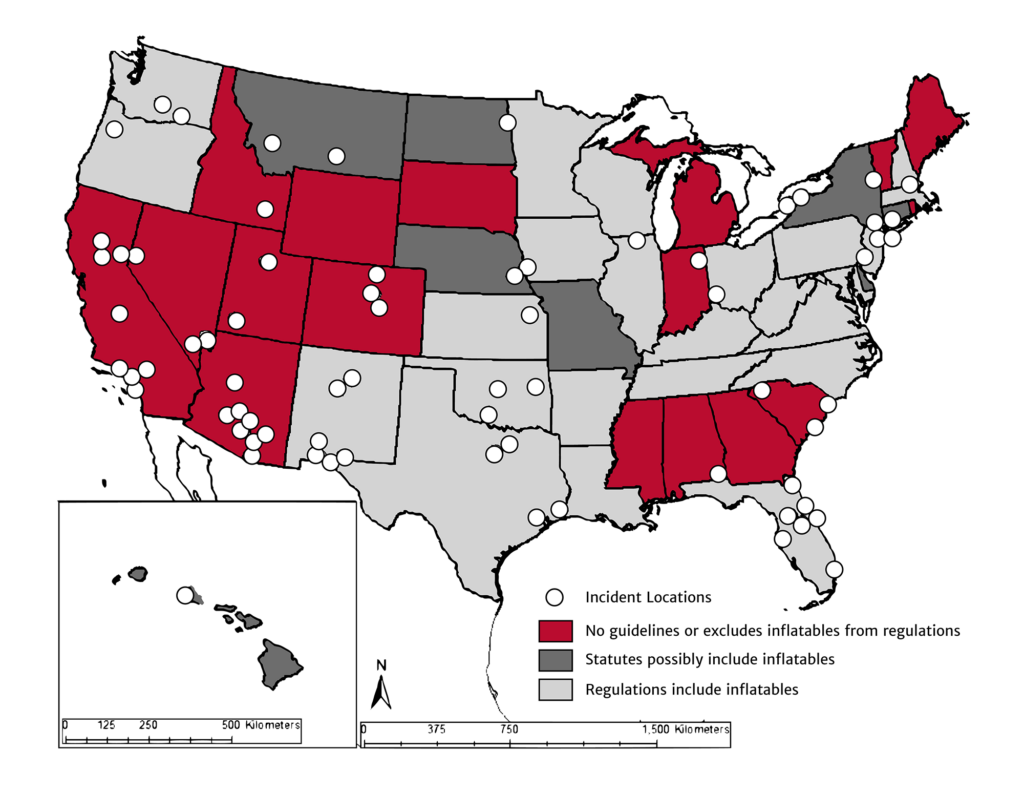
Many, but not all, of the bounce house accidents the researchers recorded occurred in states where there are no regulations governing bounce house use (shown here in red). (Infographic by Lindsay Robinson)
Only 19 states’ regulations cite the American Society for Testing and Materials (ASTM) standards, which set a maximum wind gust speed of 25 miles per hour unless the bounce house has been secured by a professional engineer. The rules also require an expert meteorologist on site for commercial use of the bounce house.
However, of the 132 bounce house incidents, more than one in five occurred at wind speeds below those considered unsafe by ASTM standards. More than a third of the crashes occurred with observed wind speeds between 0 and 20 mph, and more than half occurred at or below the 25 mph mark.
“Before a strong wind event, we encourage people to secure outdoor items and remove loose limbs from trees to prevent damage or injury once the wind starts to pick up,” said Danielle Nagele, coordinator of the public program of the National Meteorological Service who did not participate. in the study “New information and research, like this study, can help improve public awareness of wind-related risks.”
Watch the weather, protect the bounce house and monitor the game to keep the kids safe
This publication is the first academic study to examine wind-related bounce house accidents.
Researchers spent a decade looking for wind-related incidents, resulting in tens of thousands of Google searches and alerts to trace the locations, date and weather conditions of each of the 132 documented cases found around the world. Several authors conducted independent analyzes using a variety of sources, including National Weather Service observations and satellite imagery to classify weather conditions. The researchers also conducted independent analyzes and classifications of state regulations for inflatable devices.
The researchers used this information to create a web site document their findings and provide consumer safety advice.
Wind-related incidents and accidents are only a small part of the overall safety hazard of bounce houses.” —Thomas Gill, University of Texas at El Paso
The most important things people can do to safely enjoy bounce houses are to watch the weather, set up bounce houses properly with stakes and/or sandbags, and always have an adult supervise the behavior of bouncers. bounce houses
“Make taking wind measurements part of the fun of the event,” Gill said. “Wind-related incidents and accidents are only a small part of the overall safety hazard of bounce houses. Although they are great fun, there are dangers with them and people should take them seriously.”
The study was recently published online at the Bulletin of the American Meteorological Society. It was co-authored by Castle Williams, a UGA Ph.D Department of Geography and social science contractor supporting the National Oceanic and Atmospheric Administration; Jada Smith, undergraduate researcher in the Department of Geography; UGA graduate Lucas Boggs Faculty of Law and practicing lawyer; Alan Black, Ph.D. Department of Geography and Assistant Professor at Southern Illinois University Edwardsville; and Hope Skypek, a Geography Department graduate and Law School student.